New Jersey Expands Job-Protected Leave for Workers
New Jersey has expanded job-protected leave, giving more workers protections and creating new responsibilities for employers.
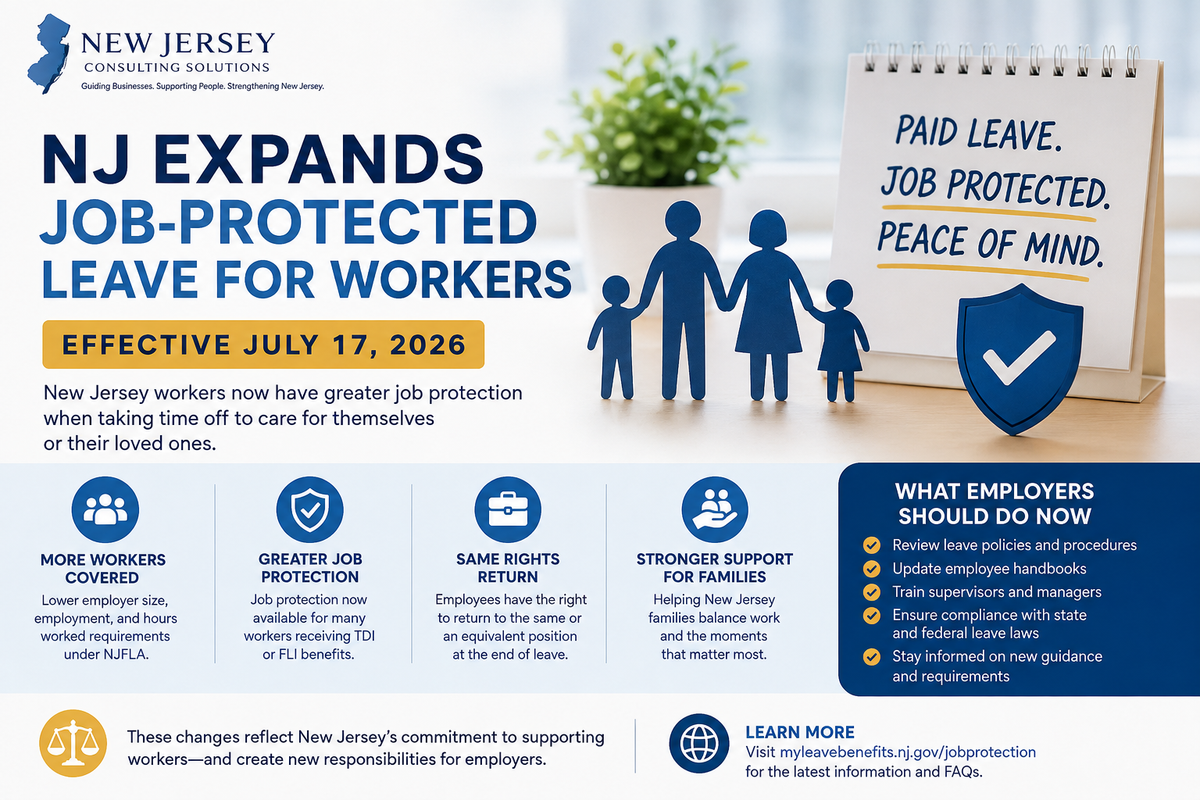
Effective July 17, 2026, New Jersey significantly expanded job-protected leave protections for employees, creating important new responsibilities for employers across the state.
New Jersey employers should be aware of major changes to the state’s family and medical leave protections that took effect on July 17, 2026.
The new law expands job protection for workers receiving Temporary Disability Insurance (TDI) and Family Leave Insurance (FLI) benefits while also lowering the eligibility requirements under the New Jersey Family Leave Act (NJFLA).
For businesses, particularly small and mid-sized employers, these changes may require updates to employee handbooks, leave policies, internal procedures, supervisor training, and human resources practices.
Expanded Job Protection for TDI and FLI Recipients
One of the most significant changes is the expansion of job protection for employees who receive TDI or FLI benefits through the State of New Jersey or an approved private plan.
Previously, an employee could qualify for wage-replacement benefits without necessarily having job protection under another leave law.
Under the new provisions, qualifying employees receiving TDI or FLI benefits may now have their employment protected during leave when that leave is not already protected under the New Jersey Family Leave Act.
At the conclusion of qualifying leave, employees generally have the right to return to the same position or an equivalent position with comparable:
- Pay
- Benefits
- Seniority
- Employment status
- Terms and conditions of employment
Significantly, the new TDI/FLI job-protection provisions do not include a minimum employer-size requirement or a minimum length-of-employment requirement.
This means the law may now affect employers and workers who previously fell outside traditional family-leave protections.
More Employees Now Qualify Under the NJ Family Leave Act
The eligibility requirements under the New Jersey Family Leave Act have also been substantially reduced.
Beginning July 17, 2026:
Employer Size
The previous threshold of 30 or more employees worldwide has been reduced to 15 or more employees worldwide.
State and local government agencies remain covered regardless of size.
Length of Employment
Employees previously needed to work for their employer for at least 12 months.
That requirement has now been reduced to three months.
Hours Worked
The previous requirement of 1,000 hours worked during the preceding 12 months has been reduced to 250 hours.
These changes significantly increase the number of employees who may qualify for job-protected family leave.
What NJFLA Continues to Provide
Eligible employees may continue to receive up to 12 weeks of job-protected leave within a 24-month period for qualifying family-related reasons.
These may include:
- Bonding with a newborn child
- Bonding following adoption or foster placement
- Caring for a family member with a serious health condition
Employees generally have the right to return to their position following qualifying NJFLA leave.
The New Jersey Family Leave Act is enforced by the New Jersey Division on Civil Rights.
TDI and FLI Benefit Eligibility Has Not Changed
While job protections have expanded, eligibility for TDI and FLI wage-replacement benefits continues to be based primarily on earnings.
For claims beginning in 2026, workers generally must have either:
- Worked at least 20 weeks earning at least $310 per week; or
- Earned at least $15,500 during the applicable base year.
Employers should remember that eligibility for cash benefits and eligibility for job protection are separate legal considerations.
An employee’s leave request should therefore be reviewed under all potentially applicable state and federal laws.
Federal FMLA Requirements Remain the Same
The federal Family and Medical Leave Act (FMLA) has not changed as a result of New Jersey’s new law.
Federal FMLA generally requires:
- An employer with at least 50 employees within a 75-mile radius, or an eligible government agency
- At least 12 months of employment
- At least 1,250 hours worked during the previous 12 months
Federal FMLA is enforced by the U.S. Department of Labor.
What New Jersey Employers Should Do Now
The July 2026 changes create important compliance considerations for New Jersey employers.
Businesses should review their current policies and procedures to determine whether updates are necessary.
Employers should consider:
- Reviewing employee handbooks and written leave policies
- Updating internal TDI, FLI, and NJFLA procedures
- Training supervisors and managers on expanded employee protections
- Reviewing how leave requests are documented and processed
- Confirming that employees returning from protected leave are properly restored to their positions
- Coordinating state and federal leave laws when multiple protections may apply
- Monitoring additional guidance and formal regulations issued by the State of New Jersey
Employers with 15 to 29 employees should pay particular attention to these changes, as many may now be subject to NJFLA requirements for the first time.
Compliance Is More Important Than Ever
New Jersey’s expanded leave protections reflect a broader effort to provide workers with greater employment security when caring for themselves and their families.
For employers, however, the changes also create additional compliance responsibilities.
Understanding the distinction between paid leave benefits and job-protected leave is critical.
Businesses should avoid relying on outdated policies or assuming that an employee is ineligible simply because the organization is small or the employee has only recently joined the company.
As state agencies continue to issue additional guidance, employers should remain proactive and ensure that their workplace policies remain consistent with current New Jersey law.
How New Jersey Consulting Solutions Can Help
New Jersey Consulting Solutions assists businesses and organizations with workplace compliance, policy development, employee relations, workforce practices, and organizational planning.
Employers that may be affected by these new leave requirements should consider reviewing their employee handbook and internal leave procedures to ensure they reflect the July 17, 2026 changes.
For assistance with policy reviews, workforce compliance planning, or updating internal employment procedures, contact New Jersey Consulting Solutions.
This article is provided by New Jersey Consulting Solutions for general informational purposes only and does not constitute legal advice. Employers and employees should consult qualified legal counsel or the appropriate state or federal agency regarding specific circumstances.